Reading a Pet Food Label Like a Vet Tech
How to read a pet food label the way veterinary professionals do. Ingredient order, AAFCO statements, guaranteed analysis, and what the front of the bag hides.
Quick answer: Ignore the front of the bag and read the back in this order: the ingredient list (the first two ingredients should be named animal proteins), the AAFCO statement (feeding-tested is stronger than "formulated to meet"), the guaranteed analysis percentages, and the manufacturer's credibility, including whether a board-certified veterinary nutritionist is on staff and the brand's recall history. Those few items tell you more than any marketing term on the front.
The front of a pet food bag is a marketing surface. The back of the bag is a regulatory document. The two often disagree, and the regulatory document is the one telling you the truth.
This is a working guide to reading a pet food label the way veterinary technicians and pet nutritionists do. Once you can read a label this way, you stop being persuaded by mountain imagery and start making decisions based on what is actually in the bag.
The front of the bag means almost nothing

Before we get to the back, a quick acknowledgment of what to ignore.
The front of the bag is governed by labeling rules that allow words like "natural," "premium," "holistic," and "human-grade" without strong definitions. Some of these terms have AAFCO definitions but loose enforcement. Some have no real definition at all.
What "natural" means on a pet food bag: the ingredients are not synthetic, with the exception of synthetic vitamins and minerals (which are allowed). It does not mean the ingredients are high-quality or free of processing.
What "premium" means: nothing. There is no regulatory definition. Any food can call itself premium.
What "holistic" means: nothing. Same as premium.
What "human-grade" means: this one has more teeth. The food must be made in a facility that meets human food safety standards and contains only ingredients fit for human consumption. This is genuinely meaningful but is rare and usually clearly labeled.
The mountain on the bag, the wolf on the bag, the words "real meat" in big letters: ignore all of it. Turn the bag over.
The ingredient list: read in order
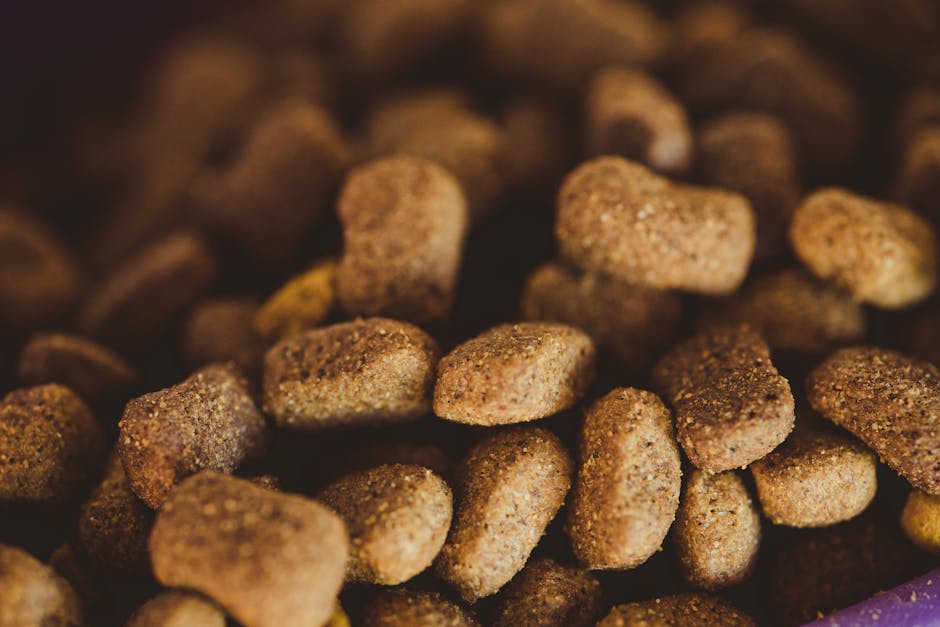
Ingredients are listed by weight, before cooking. This sounds simple but contains a couple of tricks.
The first ingredient should be a named animal protein. "Chicken," "beef," "salmon," "lamb." Not "meat by-products." Not "meat meal" with no animal specified.
But here is the trick: fresh chicken is about 70 percent water. After cooking and processing, it shrinks dramatically. A bag with chicken as the first ingredient may actually have more grain or vegetable matter by final dry weight than chicken, because the chicken weight included its water.
The fix: look at the next two or three ingredients. If chicken is first followed by chicken meal (which is chicken with the water already removed), the food has substantial chicken content. If chicken is first followed by corn, soybean meal, and corn gluten meal, the food is mostly grain after the moisture leaves the chicken.
Meal versus fresh. Meat meal sounds worse than fresh meat. It is actually often better in dry food. Meat meal is meat that has been rendered (cooked and dried) to remove water before being added to the kibble. The result is a denser, more concentrated source of animal protein. A bag listing "chicken meal" first has more chicken protein than a bag listing "fresh chicken" first, despite the front-of-bag marketing implying the opposite.
By-products. "Chicken by-products" means everything except the prime meat: organs, beaks, feet, feathers (sometimes). The quality varies wildly depending on the supplier. By-products from a high-quality source can include nutrient-dense organ meats. By-products from a low-quality source can include rendered slaughter waste of unclear composition. The label does not tell you which.
A general rule: if you see "meat by-products" or "meat by-product meal" without a species named (just "meat"), the source is unspecified and probably mixed. Avoid. If you see a specific species ("chicken by-product meal"), the food is sourcing within a known category, which is better.
Generic categories like "animal fat" or "meat meal." These are red flags. They mean the manufacturer is buying whatever is cheapest week to week and the composition can shift. A reputable food specifies the source: "chicken fat (preserved with mixed tocopherols)" rather than "animal fat."
The Guaranteed Analysis

Every pet food bag has a Guaranteed Analysis box that lists minimum and maximum percentages for key nutrients. It is a regulatory requirement.
Crude protein, minimum. This is the protein content of the food, including protein from any source (meat, plant, etc.). For an adult dog food, look for a minimum of 22 to 25 percent. For active dogs or puppies, 28 percent or higher is reasonable. For cats, minimum 30 percent.
The "crude" part means this is the total nitrogen content, converted to protein equivalent. It does not distinguish between high-quality animal protein and low-quality plant protein. A food with 26 percent crude protein from chicken and chicken meal is much different from a food with 26 percent crude protein from corn gluten meal and soybean meal, even though the percentages match.
This is why the ingredient list is more useful than the GA percentages alone. The GA tells you the quantity of protein. The ingredient list tells you the quality.
Crude fat, minimum. Adult dogs need 8 to 15 percent fat depending on activity level. Cats need 9 to 15 percent. Lower fat than this is rarely appropriate; it is usually a sign of a "weight loss" or "indoor formula" food that may be undersupplying.
Crude fiber, maximum. Should be 4 to 6 percent for most dogs and cats. Higher than 6 percent suggests heavy plant-fiber inclusion, which is more about bulking the food than nutrition.
Moisture, maximum. For dry food, 10 to 12 percent. For wet food, 75 to 82 percent. The number itself is less important than knowing where you are; you compare wet foods to other wet foods, dry to dry.
Ash, where listed. Not always shown but useful. Ash represents the mineral content of the food after burning off everything organic. Should be 5 to 8 percent for most dry foods. Substantially higher suggests excessive bone or mineral inclusion.
The AAFCO statement
The single most important sentence on the bag.
It will read either:
"[Product name] is formulated to meet the nutritional levels established by the AAFCO Dog/Cat Food Nutrient Profiles for [life stage]."
or
"Animal feeding tests using AAFCO procedures substantiate that [product name] provides complete and balanced nutrition for [life stage]."
The second one is stronger. "Formulated to meet" means the food was calculated on paper to meet nutritional requirements. "Animal feeding tests substantiate" means the food was actually tested on dogs or cats and they remained healthy on it for the duration of the trial.
Foods with feeding-tested labels have empirical evidence behind them. Foods with formulated-only labels have spreadsheet evidence. Both can be appropriate, but feeding-tested is the higher standard.
The life stage matters too. "All life stages" is a single formulation that meets the requirements for both adults and growing puppies/kittens. "Adult maintenance" is for adults only. "Growth and reproduction" is for puppies and kittens, lactating mothers. Feeding an "adult maintenance" food to a puppy can cause real growth problems; feeding a "growth" food to a senior can drive weight gain.
If the bag does not have an AAFCO statement at all, the food is being sold as a "supplemental" or "treat" rather than a complete diet. Check carefully. Some boutique foods slip into this category and shouldn't be the sole food.
The manufacturer information

Look for:
- Manufacturer name and address. Required by law.
- Whether the food is "manufactured by" or "manufactured for." "Manufactured by" means the company on the bag also makes the food. "Manufactured for [Brand]" means the food is co-packed by another facility. Co-packing is normal and not a problem in itself, but it does mean quality control depends on the co-packer's practices.
- Country of origin. Some labels distinguish between where the food was made and where individual ingredients were sourced from. Quality concerns about international ingredient sourcing (particularly from countries with weaker food safety regulation) are legitimate.
A food that is fully made and sourced in one country with strong food-safety regulation has a cleaner supply chain than one that is co-packed across borders with imported ingredients.
The contact and recall information
Reputable manufacturers list a customer-service phone number on the bag. Call it. Ask:
- Is there a board-certified veterinary nutritionist on staff? The answer "yes" is meaningful. The answer "we use a consultant" is acceptable. The answer "we don't have one" is a red flag for a food sold as complete and balanced.
- Where is the food manufactured? Get a specific facility location.
- Has the food had any recalls? A history of zero recalls is not necessarily good (could mean small distribution); a recall record that was handled transparently and resolved quickly is acceptable; a pattern of recurring issues is concerning.
The FDA maintains a public pet food recall and withdrawal database. Look the brand up before you commit.
Where this leaves you
After all of this, the practical heuristics for picking a food:
- First two ingredients are named animal proteins (e.g., chicken, chicken meal).
- AAFCO statement is feeding-tested for the appropriate life stage.
- Crude protein is at or above the species and life-stage minimum.
- Manufacturer has a board-certified veterinary nutritionist on staff or as a consistent consultant.
- No history of major recalls in the last five years.
- Made in a country with strong food safety enforcement.
Several mid-tier brands meet all of these, including Purina Pro Plan, Hill's Science Diet, and Royal Canin. Several premium boutique brands fail on item 4 (no veterinary nutritionist on staff) or item 2 (formulated rather than feeding-tested).
The bag price does not always correspond to the label quality. The mountain on the front does not predict any of this. Read the back. Call the company. The answer to "is this a good food" is in the regulatory document, not the marketing.
The takeaway
Pet food labels are dense and intentionally hard to parse. Once you know what to look for, the picture clarifies fast. Ingredient order, AAFCO statement, GA percentages, manufacturer credibility. Five things, in that order, and you can evaluate any food in under five minutes.
The bags that look the best are not always the foods that read the best. Read what is required to be true on the back, not what is allowed to be claimed on the front.
For the regulatory background behind these label rules, the FDA's overview of pet food labeling requirements explains what manufacturers are required to disclose and how terms are governed.
Frequently Asked Questions
What should the first ingredient in dog or cat food be?
The first ingredient should be a named animal protein such as chicken, beef, salmon, or lamb, not an unnamed "meat by-product" or generic "meat meal." Keep in mind that fresh meat is about 70 percent water, so a food listing a named meat first followed by a meat meal of the same species usually has more real animal protein than the front of the bag suggests.
Is meat meal bad in pet food?
No. Meat meal often signals more concentrated animal protein, not less. Meat meal is meat that has been rendered to remove water before being added to kibble, so it is denser in protein than fresh meat by final dry weight. A named meal like "chicken meal" is fine; the red flags are unnamed sources like "meat meal" or "animal fat."
What does the AAFCO statement on pet food mean?
The AAFCO statement tells you whether a food is complete and balanced and for which life stage. "Animal feeding tests substantiate" is the stronger version because the food was tested on animals that stayed healthy on it, while "formulated to meet" means it was calculated on paper. If there is no AAFCO statement at all, the product is a treat or supplement, not a complete diet.
How much protein should be in good dog or cat food?
Check the crude protein minimum in the guaranteed analysis. For adult dog food, look for at least 22 to 25 percent, with 28 percent or higher reasonable for active dogs and puppies. Cat food should be at least 30 percent. The percentage tells you quantity, not quality, so always read it alongside the ingredient list.
Do "natural," "premium," and "holistic" labels mean anything?
Mostly not. "Premium" and "holistic" have no regulatory definition and any food can use them. "Natural" only means the ingredients are not synthetic, aside from added vitamins and minerals, and says nothing about quality. "Human-grade" is the one term with real teeth, since it requires human-food safety standards and ingredients fit for human consumption.