How Much Exercise Does a Dog Need Each Day? By Breed and Age
Dog exercise needs by breed group and life stage. Why most owners under-exercise their dog and the realistic daily targets that prevent behavior problems.
How much exercise does a dog need? The honest answer from a former licensed insurance agent who now writes pet-care guidance.
The honest answer most owners do not want to hear: most dogs need 60 to 120 minutes of real exercise per day, and most dogs are getting less than 30. The behavior problems, weight gain, and "hyperactive" labels that follow are predictable consequences of an underexercised dog living in a small indoor space.
This is the practical reference for matching exercise to the dog you actually have. By breed group, by age, and what counts as "exercise" versus what's just walking around the block.
Here is the quick reference, so you can find your dog and your daily target before we get into the why.
| Group or life stage | Daily exercise target | Best session structure | Watch-outs |
|---|---|---|---|
| High-energy working & sporting (Border Collie, Lab, Malinois, GSD) | 90 to 120+ min | Two sessions, at least one high-intensity, plus mental work | Under-exercise drives "hyper" and destructive behavior |
| Hounds (Beagle, Greyhound, Basset) | 60 to 90 min | Scent-rich walks; short sprint bursts for sighthounds | Solid recall before any off-leash running |
| Terriers (Jack Russell, Westie, Cairn) | 60 to 90 min | Two 30 to 45 min varied sessions | High drive packed into a small body |
| Toy breeds (Chihuahua, Pomeranian, Maltese) | 30 to 60 min | Daily walk plus indoor play | Lower need, but not "no need" |
| Giant breeds (Great Dane, Mastiff, Newfoundland) | 45 to 90 min | Moderate walks with some structured play | Avoid high-impact running, especially as puppies |
| Brachycephalic (Pug, Bulldog, Boston Terrier) | 30 to 60 min | Multiple short sessions at cool times of day | Overheating and labored breathing |
| Puppies (under 12 months) | About 5 min per month of age, twice a day | Structured exercise plus free, self-paced play | Protect growth plates; no repetitive impact |
| Seniors (7+ large, 9 to 10+ small) | Reduced but still daily | Shorter, more frequent, low-impact (swimming is ideal) | Joint stiffness, especially after rest |
*Targets compiled June 2026 from American Kennel Club and American Animal Hospital Association exercise guidance, with the puppy "5 minutes per month of age" rule per veterinary and Purina guidance and the heat cautions for flat-faced breeds from the AVMA. Every dog is an individual, so read your dog and adjust.
What "exercise" actually means for a dog

Before the numbers, a definition. Exercise for a dog is not the same as a leisurely walk on a leash to sniff things. Both have value (the sniff walk is enrichment, which matters), but only the first one is exercise.
True exercise raises the dog's heart rate, makes them breathe harder, and works major muscle groups. For most dogs, that's:
- Brisk walking or jogging at a pace that elevates breathing.
- Running off-leash in a safe area.
- Fetch with sustained running.
- Swimming.
- Active play with another dog.
- Hiking on uneven terrain.
- Structured training or agility work.
- Tug-of-war (yes, real tug, not gentle pulling).
A 30-minute walk where the dog stops to sniff every three feet is roughly 8-12 minutes of actual exercise. A 30-minute brisk walk is closer to 25 minutes of actual exercise. The owner did the same amount of clock time; the dog got very different physiological output.
By breed group

Breed group is a stronger predictor of exercise need than individual breed. The major categories:
High-energy working and sporting breeds
Daily target: 90-120+ minutes
Border Collies, Australian Shepherds, Belgian Malinois, German Shepherds, Vizslas, Weimaraners, Pointers, Setters, Labradors, Goldens (when young), Boxers, Dalmatians, Cattle Dogs.
These dogs were bred for full days of physical work. Hours of running cattle, retrieving game, herding sheep. Modern domestic life provides a fraction of that, and the under-exercised version of these breeds is the canonical "destructive at home, hyperactive on walks, won't settle" dog.
Two daily exercise sessions of 45-60 minutes each, with at least one being high-intensity (off-leash run, fetch, swim, agility), is the realistic baseline. These dogs also need substantial mental work in addition to physical exercise.
Hounds
Daily target: 60-90 minutes
Beagles, Basset Hounds, Greyhounds, Whippets, Bloodhounds, Foxhounds, Coonhounds.
Sighthounds (Greyhound, Whippet) are sprinters: short bursts of high intensity, then long rest. They need a real run a few times a week and moderate walks otherwise. Scent hounds (Beagle, Basset) need sustained, scent-rich walks; off-leash running on familiar trails works well if recall is solid.
Terriers
Daily target: 60-90 minutes
Jack Russells, Yorkies, Bull Terriers, Cairn Terriers, West Highland Terriers, Patterdales.
Terriers are small but not low-energy. They were bred to dig, chase, and dispatch vermin, and the modern domestic terrier still has the same drive condensed into a smaller body. Two 30-45 minute sessions of varied activity (walks plus play plus mental work) is the realistic minimum.
Toy breeds
Daily target: 30-60 minutes
Chihuahuas, Pomeranians, Maltese, Yorkies, Pugs, Cavaliers, Shih Tzus.
Lower exercise needs in absolute terms. But "low exercise" doesn't mean "no exercise." A daily walk plus indoor play meets the requirement for most. Be careful with brachycephalic breeds (Pugs, Frenchies) in heat; their breathing is compromised and exercise tolerance is lower.
Working giant breeds
Daily target: 45-90 minutes (with caveats)
Great Danes, Mastiffs, Saint Bernards, Newfoundlands, Great Pyrenees.
Giant breeds are deceptively lower-exercise than their size suggests. They tire faster, have skeletal issues that benefit from controlled exercise, and don't need the constant high intensity of working breeds. Moderate daily walks and some structured play. Avoid high-impact running on hard surfaces, especially in puppyhood.
Brachycephalic breeds
Daily target: 30-60 minutes
Pugs, Bulldogs (English and French), Boston Terriers, Pekingese, Cavalier King Charles Spaniels.
Their flat-faced anatomy compromises breathing. Exercise tolerance is genuinely lower, and the risk of overheating is higher. Multiple short sessions are better than one long session. Cool times of day in summer. Watch for labored breathing. The American Veterinary Medical Association has clear guidance on recognizing and preventing heatstroke, which brachycephalic dogs are far more vulnerable to during exercise.
Mixed breeds
Daily target: depends on heritage
A Lab mix is closer to a Lab. A Beagle/terrier mix is closer to a hound. Look at the dominant ancestry and adjust based on energy level. The honest signal is the dog: a dog who's bouncing off the walls is probably underexercised regardless of what their breed mix says.
By age
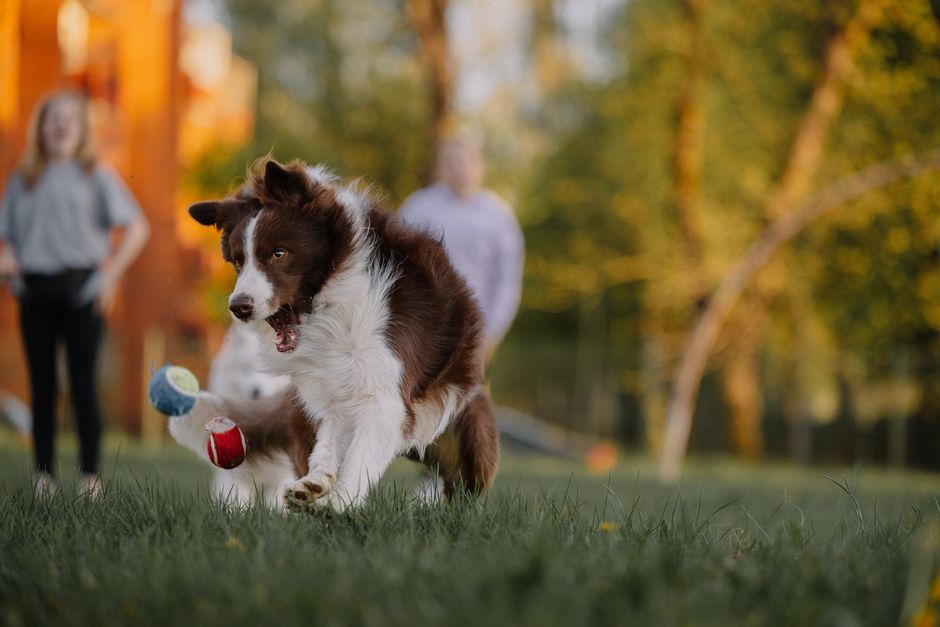
Exercise needs vary substantially by life stage, often more than by breed.
Puppies (under 12 months)
Puppies need exercise but the type matters. Their joints and growth plates are still forming, and high-impact activity (jumping, repetitive running, structured agility) can cause permanent skeletal problems.
Rule of thumb (not a strict law): 5 minutes of structured exercise per month of age, twice a day.
- 3-month-old puppy: ~15 minutes structured exercise, twice daily.
- 6-month-old: ~30 minutes structured.
- 9-month-old: ~45 minutes structured.
This is in addition to free play and exploration, which is unstructured and self-paced. A puppy can self-regulate free play; they cannot self-regulate jogging next to you on a leash. The American Animal Hospital Association has owner guidance on protecting growing joints, which is worth reading before starting any repetitive-impact routine with a puppy.
Adult dogs (1-7 years)
The full breed-specific requirements above apply. This is the period when exercise deficits show up most as behavior problems.
Senior dogs (7+ for large breeds, 9+ for medium, 10+ for small)
Reduced exercise tolerance but exercise still matters. Seniors who stop exercising decline faster than seniors who maintain a moderate routine.
Adjustments:
- Shorter sessions, more frequent.
- Lower-impact (swimming is excellent, jogging on hard surfaces is not).
- Watch for joint stiffness, especially after rest.
- Adjust based on individual capacity, not breed averages.
A 12-year-old Lab might still want 60 minutes of moderate walking; a 12-year-old Lab with arthritis might max out at 30 minutes split across two walks. Read the dog.
Why under-exercise creates problems

The behavior issues that owners typically describe as "hyperactivity," "destructive," "won't settle," "chewing things," "barking constantly," or "ignoring commands" are most often symptoms of under-exercise in a dog whose breed needs more than they're getting.
The pattern:
- Dog has unmet physical and mental energy needs.
- Energy expresses through whatever outlets are available: chewing, barking, jumping, pulling on leash, restless pacing.
- Owner interprets this as a behavior problem.
- Owner attempts to train through it without addressing the underlying cause.
- Behavior persists or worsens.
The fix is usually two things working together: more exercise, and more mental stimulation. A tired dog is, in the cliche, a good dog. The cliche is true.
Mental exercise alongside physical
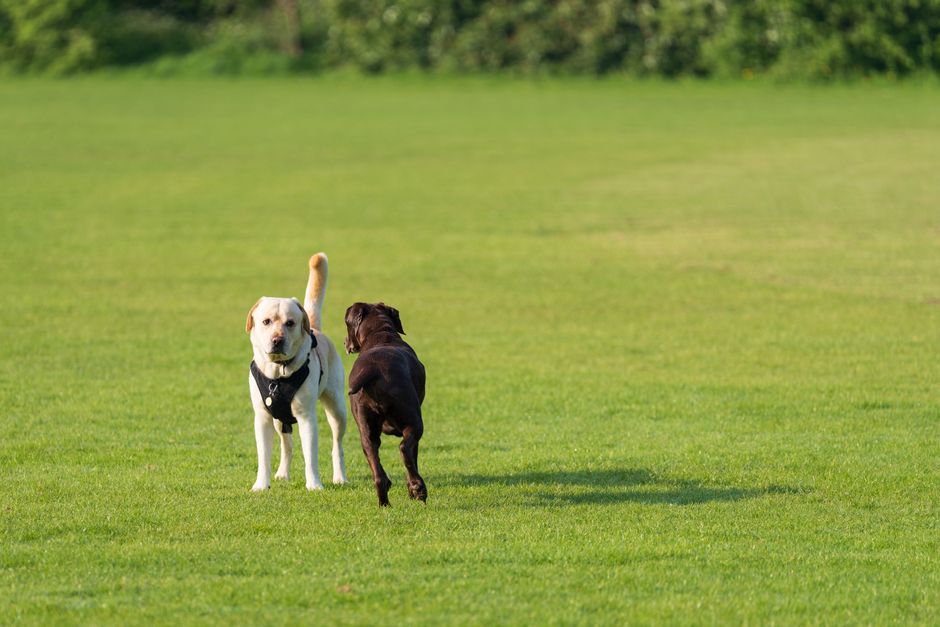
Physical exercise alone, without mental work, satisfies only part of the requirement. Working breeds in particular need cognitive engagement.
Effective mental exercise:
- Training sessions (10-15 minutes of focused work tires a working breed more than a 30-minute walk).
- Puzzle feeders.
- Scent work (hide-and-seek with treats, formal nosework).
- New environments and walks.
- Trick training.
A dog that gets 60 minutes of physical exercise plus 15 minutes of cognitive engagement is generally better behaved than a dog that gets 90 minutes of pure walking with no mental work.
What to do this week
If you suspect your dog isn't getting enough exercise:
- Assess honestly. How many minutes of true heart-rate-elevating exercise does your dog get on an average day?
- Add 30 minutes to the daily total for two weeks. Note any behavior changes.
- Vary the type. Add one session of off-leash running or active play if you've been doing only leash walks.
- Add 10-15 minutes of mental work daily.
- Reassess after two weeks. If behavior problems decreased, you found the cause. If not, the cause is something else.
For high-energy breeds in apartments without yard access: the real solution is a daily routine of two long walks, off-leash running on weekends, and substantial mental work. Anything less and you're going to fight the behavior problems indefinitely.
Frequently Asked Questions
How much exercise does a dog need each day?
Most dogs need 60 to 120 minutes of real exercise per day, and the majority get less than 30. The exact target depends heavily on breed group and age: high-energy working and sporting breeds need 90 to 120-plus minutes, hounds and terriers need 60 to 90, and toy or brachycephalic breeds need 30 to 60.
Is a daily walk enough exercise for a dog?
For many dogs, no. A leisurely walk where the dog stops to sniff constantly is enrichment, not exercise, and a 30-minute sniff walk delivers only about 8 to 12 minutes of true physiological work. Real exercise raises the heart rate through brisk walking, running, fetch, swimming, or active play, and most breeds need that on top of casual walks.
What happens if a dog does not get enough exercise?
Under-exercised dogs typically develop the behaviors owners label as hyperactivity, destructiveness, excessive barking, or refusing to settle. The unmet physical and mental energy has to go somewhere, so it expresses through chewing, pulling, and restlessness. Adding exercise and mental stimulation resolves most of these cases faster than training alone.
How much exercise does a puppy need?
A common rule of thumb is 5 minutes of structured exercise per month of age, twice a day, so a 3-month-old puppy gets about 15 minutes twice daily. This protects joints and growth plates that are still forming, which high-impact activity can permanently damage. Free, self-paced play and exploration can happen on top of that structured amount.
Does mental stimulation count as exercise for dogs?
Mental work does not replace physical exercise, but it amplifies it significantly. A 10 to 15 minute focused training session can tire a working breed more than a 30-minute walk, and a dog getting 60 minutes of physical exercise plus 15 minutes of cognitive engagement is usually better behaved than one getting 90 minutes of mindless walking.
The takeaway
Most dogs need substantially more exercise than they get. The breed and age determine the target; the behavior problems indicate when you're below it. Working and sporting breeds need 90-120+ minutes daily. Hounds and terriers need 60-90. Toys and brachycephalics need 30-60. Seniors need less but still need something.
Mental work amplifies the effect of physical exercise. A short, focused exercise routine paired with cognitive engagement outperforms a long, mindless walk.
Match the dog to the routine, watch the body for signals, and the behavior problems usually take care of themselves.
When the dog cannot do the routine it used to
A dog who was meeting its exercise target and now stops on walks, sits down mid-route, or struggles on stairs is not being stubborn. Arthritis and hip dysplasia show up first as reduced stamina, and both respond well to early, ongoing treatment rather than the wait-and-see most owners default to.
Dutch gets you a licensed vet over video the same day, joint and pain medication shipped in most states, and unlimited follow-ups to titrate the dose as the dog responds, for $132 a year. Use your local clinic for the X-ray; use this for the months of adjustment that follow it.