The Hidden Cost of Cheap Dog Food: A 10-Year Math Breakdown
Cheap dog food saves on the bag. The decade-long cost is a different number. We do the math on bag price, vet visits, dental work, and life expectancy.
Quick answer: Cheap kibble looks like a bargain on the bag, but over ten years the avoidable vet costs it creates (skin issues, dental disease, obesity-related conditions, inflammation-driven illness) run an estimated $5,700 to $17,100. That gap typically erases the bag-price savings, and dogs on better diets tend to live 1 to 2.5 years longer. Mid-tier brands are usually the best value: roughly cost-neutral over a decade once vet costs are factored in.
The bag of dog food in front of you costs $25. The premium bag two shelves up costs $75. You do the rough math, decide a 3x premium is excessive, and walk out with the $25 bag. That math is correct on the day you buy it. It is not correct over the ten years that bag of food, refilled monthly, will be feeding your dog.
What follows is the actual ten-year math on cheap kibble versus a mid-tier or premium diet, with vet outcomes, life expectancy data, and the parts of the cost that almost nobody calculates at the pet store.
Here is the part the bag price hides: the avoidable veterinary costs a cheap diet tends to create over a dog's life, the ones we walk owners through line by line.
| Avoidable cost category | Why a cheap diet drives it | Typical cost basis | Estimated 10-year cost |
|---|---|---|---|
| Skin and coat problems | Cheap grains and rendered fats inflame sensitive dogs, leading to chronic itch and ear infections | $200 to $600 per year | $2,000 to $6,000 |
| Dental disease | Kibble does not clean teeth; 80 to 90 percent of dogs show periodontal disease by age 3 | $400 to $1,200 per cleaning | $1,200 to $3,600 (2 to 3 cleanings) |
| Obesity-related conditions | Calorie-dense, high-carb formulas drive weight gain; about 56 percent of US dogs are overweight | Joint surgery, diabetes, and related care | $1,500 to $4,000 |
| Inflammation-driven illness | Inflammatory ingredients track with higher rates of allergies, GI problems, and some cancers | Added lifetime vet care | $1,000 to $3,500 |
| Total avoidable vet cost | $5,700 to $17,100 |
*Figures verified June 2026 from the AVMA (pet obesity and periodontal disease), 2026 veterinary dental-cost surveys, and the Purina Life Span Study, which found dogs kept at a lean weight lived a median 1.8 years longer than heavier littermates. These are estimates that vary by region and dog, so confirm with your vet.
The bag price spread

For a 50-pound adult dog eating about 3 cups a day, monthly food costs run roughly:
- Grocery-store value brand: $25 to $40
- Mid-tier brand (Purina Pro Plan, Hill's Science Diet, Royal Canin): $60 to $90
- Premium / boutique kibble (Orijen, Acana, Stella & Chewy's): $90 to $140
- Fresh-cooked subscription (Farmer's Dog, Ollie, Spot & Tango): $200 to $400
- Raw / frozen direct-to-consumer (Raw Wild, We Feed Raw): $250 to $450
Over ten years, the bag-price difference between cheap kibble and premium is somewhere between $5,000 and $14,000. That is the number people compare. It is also the wrong number, because it ignores everything that happens to the dog as a result of eating the cheaper food.
What is actually in cheap kibble

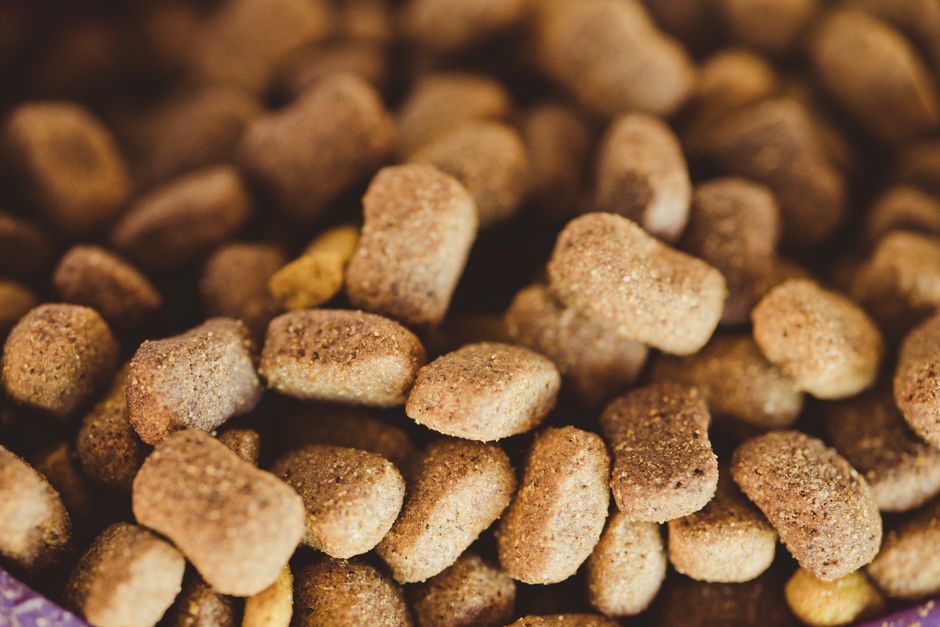
Walk down the value-brand aisle and read the first five ingredients on a typical $25 bag. You will see something like: corn, meat by-product meal, soybean meal, animal fat (preserved with mixed tocopherols), corn gluten meal.
Translated:
- Corn. Cheap carbohydrate filler. Dogs digest it, but it provides bulk and calories, not much else.
- Meat by-product meal. This is the parts of the slaughter animal that do not enter the human food chain. It can be reasonably nutritious if the source is well-controlled, but the regulation is loose enough that what is in any given bag varies considerably.
- Soybean meal. Plant protein, cheaper than animal protein, but with an amino acid profile that is not ideal for dogs.
- Animal fat (preserved). Generic rendered fat from unspecified sources, usually held stable with synthetic preservatives or, in better cases, mixed tocopherols (vitamin E).
- Corn gluten meal. A protein concentrate from corn. Inflates the protein number on the label without providing the amino acid profile of meat protein.
A premium kibble starts with a named meat (chicken, lamb, salmon) as the first ingredient, followed by a meat meal of the same protein, then named vegetables and fruits. The shift in ingredient quality maps directly to differences in protein bioavailability, fatty acid profiles, and the absence of fillers that trigger inflammation in sensitive dogs. For help reading a label objectively, Cornell University's College of Veterinary Medicine offers vet-backed guidance on evaluating dog food.
The vet bills the cheap diet creates
This is where the math gets uncomfortable.
Skin and coat issues. Dogs on diets heavy in cheap grains and rendered fats are more likely to develop chronic skin conditions, recurring ear infections, and patchy coats. The annual cost of antibiotic ear washes, medicated shampoos, and the occasional dermatology referral is conservatively $200 to $600 per year for a dog with chronic flare-ups. Over ten years: $2,000 to $6,000.
Dental disease. Cheap kibble does not actually clean teeth, despite long-standing marketing claims to the contrary. By age seven, the average kibble-fed dog has stage 2 to 3 periodontal disease and will need at least one professional cleaning under anesthesia. Cleaning runs $400 to $1,200 depending on extractions. Most dogs on cheap food will need two or three of these over their lifetime. Cost: $1,200 to $3,600.
Obesity-related conditions. Cheap kibble is calorically dense and high in carbohydrates, which contributes to weight gain. Obese dogs cost their owners more in joint surgeries, insulin for diabetes (yes, dogs get type 2), and shorter lives in general. The American Veterinary Medical Association documents the links between excess weight and conditions like arthritis, diabetes, and reduced lifespan. Average lifetime obesity-related vet costs: $1,500 to $4,000.
Inflammation-driven chronic illness. This is harder to put a hard number on, but the data is consistent. Diets high in inflammatory ingredients are associated with higher rates of allergies, gastrointestinal problems, and certain cancers. Average added vet costs over a lifetime for these issues: $1,000 to $3,500.
Sum of avoidable veterinary costs from a cheap diet: $5,700 to $17,100 over ten years.
That number alone closes most of the bag-price gap with mid-tier food, and on the high end exceeds it.
The life expectancy gap

The harder data point: dogs on better-quality diets live longer. Multiple longitudinal studies put the gap at roughly 1 to 2.5 years for medium and large breeds, depending on the comparison.
For most owners, the years a dog is alive matter more than any dollar figure. If you are choosing between food that gives you eleven years with your dog and food that gives you nine, the "savings" on the cheaper bag are not really savings.
Even on a cold financial basis: an extra year or two of an older dog you love is something most owners would pay several thousand dollars to extend if it were a one-time medical decision. Buying premium food is, in a way, that medical decision distributed over the dog's life.
What about the middle tier

You do not have to jump from $25 kibble to $400-a-month fresh-cooked subscriptions to get most of the benefit. The mid-tier brands (Purina Pro Plan Sport, Hill's Science Diet, Royal Canin breed-specific lines) are formulated by veterinary nutritionists with rigorous quality control and produce significantly better outcomes than value-brand kibble. They run $60 to $90 a month.
The math at this tier:
- Bag-price increase over cheap kibble: $35 to $65/month, or $4,200 to $7,800 over ten years
- Vet-cost reduction: $4,000 to $12,000 over ten years
- Net cost: roughly even, with better outcomes and longer life
That is the cleanest argument for a category most owners overlook. You do not need to go full premium to escape the trap.
The premium and raw tiers

For owners who want to move further up, the math gets more expensive but the health outcomes also improve. Premium kibbles built around named meats and minimal fillers are a meaningful upgrade. Fresh-cooked subscriptions and raw diets offer the biggest improvements in coat quality, dental health, energy, and stool quality, at the highest monthly cost.
If you are considering raw, the realistic options are not "make it yourself" (which can be done correctly but takes serious study) and "buy the most expensive grocery-store option" (often heavily processed). The middle ground is direct-to-consumer raw brands that ship complete frozen meals. Raw Wild is one example, using wild-sourced deer and elk meat shipped frozen. The cost is substantially higher than kibble, but the underlying argument is the one this whole article has been making: what you save on the bag, you spend on vet bills.
Where most owners actually land
After running this math out loud, most owners settle in one of three places:
- Stay on cheap food, accept the trade-offs. Some owners genuinely cannot afford to spend more, and a fed dog is better than no dog. If this is you, focus on dental care (daily brushing, dental chews, regular cleanings) since that is where the biggest avoidable vet costs accumulate.
- Move to mid-tier kibble. Cheapest cost-effective upgrade. Roughly cost-neutral over ten years once vet costs are factored in. Best ROI of any move on this page.
- Skip kibble entirely for raw or fresh-cooked. Most expensive option, but the health outcomes (coat, dental, weight, energy) are visibly better and tend to compound with age. Most appropriate for owners who can absorb the higher monthly cost and want to maximize their dog's healthspan.
The wrong answer in any of these is "premium boutique kibble that costs as much as fresh-cooked food but is still kibble." That is the worst of both worlds: paying a fresh-food price for an extruded product. If your budget will support $400 a month, spend it on actual fresh food, not boutique kibble.
Frequently Asked Questions
Is cheap dog food actually worse for my dog?
Over a single month, cheap kibble saves real money. Over ten years, the picture changes. Value-brand foods are built around fillers like corn, by-product meal, and rendered fat, and they are associated with higher rates of skin issues, dental disease, obesity, and inflammation-driven illness. The avoidable vet costs they create tend to erase the upfront savings.
How much does cheap dog food really cost over a dog's life?
The bag-price difference between cheap kibble and premium runs roughly $5,000 to $14,000 over ten years. But the avoidable veterinary costs a cheap diet tends to create are estimated at $5,700 to $17,100. Once you add those in, the cheap bag is rarely the cheaper option.
Does better dog food really help dogs live longer?
Multiple longitudinal studies put the life-expectancy gap at roughly 1 to 2.5 years for medium and large breeds on better-quality diets, depending on the comparison. Diet is not the only factor in lifespan, but it is one of the few an owner controls daily, and the effect compounds with age.
Is premium dog food worth the extra money?
Often the best value is the middle tier, not premium boutique kibble. Mid-tier brands formulated by veterinary nutritionists cost $60 to $90 a month and tend to be roughly cost-neutral over ten years once vet savings are counted. The worst value is boutique kibble priced like fresh food: if your budget supports that, spend it on actual fresh or raw food instead.
If I can only afford cheap food, what should I prioritize?
A fed dog is better than no dog, so if budget is the constraint, focus spending where avoidable costs accumulate fastest: dental care. Daily brushing, VOHC-approved dental chews, and regular cleanings prevent the single most expensive and most common chronic problem in dogs, which blunts much of the downside of a cheaper diet.
The takeaway
The bag in front of you is not the cost of feeding your dog. It is the cost of feeding your dog this month. The cost of feeding your dog over their lifetime includes the dental cleanings, the skin treatments, the obesity-driven joint surgeries, and the years of life that diet quality is silently buying or not buying.
Run that math before you decide what is "too expensive." The cheap bag is rarely the cheap option.